
Here’s a pattern worth noticing. Ask ten different sources what sildenafil’s risks look like and you’ll get ten different walls of small print, headache here, a rare warning there, no sense of what’s common versus what’s catastrophic. That’s not much use to anyone trying to make an actual decision. So this piece starts from a different place: the numbers themselves, sorted by how often something happens and how bad it is when it does. Read it once and you’ll have the whole picture. The short version is that sildenafil’s safety record is almost entirely reassuring, with one clear exception that changes how you should think about getting the medication at all.
One thing to say plainly before any of that: whether sildenafil is right for you, and at what dose, isn’t something a list of statistics can settle. That’s a conversation for a licensed clinician who knows your health history and your medication list. Everything below describes what tends to happen across groups of men, not what will happen to you specifically.
The overview: what the long-term data actually show
Start with the number that does the most work. A multicenter study followed nearly a thousand men taking sildenafil, with flexible dosing, for four full years. Over that stretch, side effects serious enough to require changing the dose or stopping the drug altogether showed up in under 4 percent of participants, and none of those were classified as serious [1]. That’s a low bar cleared easily.
Meanwhile, at every single yearly check-in across those four years, more than 94 percent of the men said they were satisfied and that the drug had improved their ability for sexual activity. No tolerance built up. The effect didn’t fade [1]. Put those two figures side by side and you get something worth sitting with: for roughly every unhappy outcome, there were more than twenty satisfied ones. That’s not a marketing claim, it’s just what the ratio of 94 to under-4 looks like when you line it up.
A drug that holds steady like that, strong and stable benefit against a small and mostly mild cost, earns a favorable read. But “mostly favorable” is not the same as “no exceptions,” and the rest of this piece is about being honest about the one that isn’t.
The worry: “which side effects should actually concern me?”
This is usually the real question underneath all the caveats, so let’s answer it directly by breaking the side effects into three groups: the ones that are common and forgettable, the ones that are rare but worth knowing, and the one that is neither common nor forgettable.
The everyday stuff. Headache, a flushed face, a stuffy nose, indigestion, and mild visual changes, sometimes a temporary blue tinge, sometimes light sensitivity, are the effects most men will recognize if they experience anything at all [2]. They all come from the same source: sildenafil widens blood vessels to improve blood flow where you want it, and that widening happens elsewhere in the body too. That’s the whole mechanism showing up as a mild nuisance. These effects also scale with dose, which is useful information, because if they bother you, a lower dose usually settles them without switching medications. Annoying, yes. Dangerous, no.
The rarer effects worth recognizing. A smaller category sits below that: an erection that’s painful or lasts unusually long, or sudden changes in vision or hearing. These are genuinely uncommon, not the typical experience by any measure, but they’re the kind of thing you want to recognize immediately if it happens, because the right response is to seek care promptly rather than wait it out. Awareness here, not alarm, is the right posture.
The one that’s different in kind. Then there’s the interaction that isn’t really a “side effect” at all, it’s a contraindication, and it deserves its own section because lumping it in with headaches would be misleading.
The answer: why nitrates are the one thing that actually matters
Sildenafil has exactly one interaction that is genuinely dangerous, and it’s with nitrates. That covers prescription nitrates for chest pain and angina (nitroglycerin, isosorbide dinitrate or mononitrate), and it also covers recreational inhalant “poppers” (amyl nitrite). All of them work through the same nitric oxide pathway that sildenafil amplifies. Combine the two and the blood-pressure-lowering effects don’t just add, they compound into severe, potentially life-threatening hypotension.
This is worth separating clearly from everything discussed above, because it doesn’t behave the same way. The common side effects are frequent but mild. This is uncommon in the population overall but can be genuinely dangerous for the specific person who crosses the line. StatPearls states it without hedging: coadministration of sildenafil with nitrates is contraindicated because of the risk of severe, life-threatening hypotension acting synergistically [2]. The joint expert consensus document from the American College of Cardiology and American Heart Association exists specifically to walk clinicians through this exact interaction [3]. The practical guidance is to keep at least 24 hours, roughly five half-lives, between a nitrate and a dose of sildenafil [2].
Here’s the part that matters most for how you think about getting the medication: this risk can’t be managed by adjusting the dose. Lowering the amount you take doesn’t make the combination safer, because the danger isn’t the dose, it’s the pairing. The only real safeguard is knowing, before the tablet is ever prescribed, whether the person taking it uses nitrates for the heart or recreationally. That single question is the whole ballgame.
The path: what this means for how you get the medication
If you accept everything above, the practical takeaway isn’t complicated. Most of sildenafil’s safety story is favorable and largely self-managing, mild effects that ease with a dose adjustment, rare effects that call for prompt attention if they show up. But the one part of the story that’s genuinely serious is also the one part that can’t be caught by the person taking the pill. It has to be asked about, upfront, by someone qualified to ask it.
That’s the reason the source of your prescription matters as much as the prescription itself. A seller that ships pills with no questions asked doesn’t touch any of the mild, manageable side effects, those stay exactly the same either way, but it removes the one screening step that actually protects against the dangerous outcome. A physician-supervised telehealth route such as FormBlends is built around exactly this: a licensed clinician reviews your history, asks about nitrate use and cardiovascular risk, and only then prescribes, with the medication dispensed through licensed pharmacies. That review is the same safeguard the cardiology consensus document was written to support [3]. Given that nearly all of sildenafil’s risk lives in this one screenable question, that screening step isn’t a formality. It’s the actual point of going through a supervised process rather than around one.
The numbers, gathered in one place
- Side effects serious enough to change treatment: under 4 percent over four years, none classified as serious in that group [1].
- Satisfaction at each yearly check: more than 94 percent, with no drop-off and no tolerance building up [1].
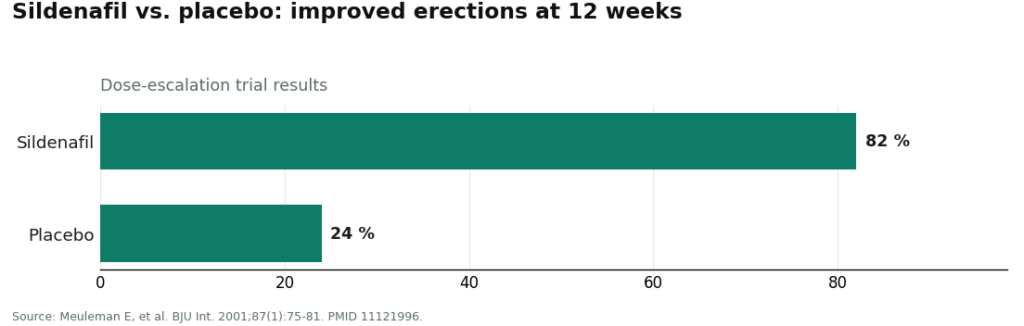
- Efficacy for context: 82 percent of men reported improved erections on sildenafil versus 24 percent on placebo at twelve weeks [4].
- The everyday effects: headache, flushing, congestion, indigestion, visual changes, all mild, temporary, and tied to dose [2].
- The one exception: nitrates. Absolute contraindication, risk of severe hypotension, no dose fixes it, only avoidance and a roughly 24-hour gap [2][3].
Questions readers tend to ask next
Is sildenafil actually dangerous, or does it just have a scary reputation?
For most men, it’s a low-risk medication, and the reputation tends to overstate the general danger while understating the one specific one. The four-year data show side effects severe enough to change treatment in under 4 percent of participants, with none classified as serious in that group [1]. The real risk isn’t spread evenly across the drug’s profile, it’s concentrated almost entirely in one interaction.
What’s the one thing about sildenafil that’s genuinely risky?
Taking it alongside nitrates. That includes prescription nitrates like nitroglycerin and isosorbide, and it includes recreational poppers. Both work through the same vessel-widening pathway sildenafil uses, and combining them can cause a severe, potentially life-threatening drop in blood pressure [2][3]. This isn’t something a smaller dose fixes. The guidance is to keep roughly 24 hours between the two [2].
Do the common side effects mean something’s wrong?
Usually not. Headache, flushing, a stuffy nose, indigestion, and a temporary blue tint to vision all trace back to the same vessel-widening effect that makes sildenafil work in the first place, and for most men they’re mild and pass on their own [2]. Because they track the dose, a lower amount often eases them, which is why a prescriber will typically adjust the dose before considering a different medication.
Does sildenafil stop working the longer you use it?
The four-year data say no. Satisfaction stayed above 94 percent at every yearly check, with no sign of tolerance and no fading of effect [1]. So the benefit tends to hold steady rather than wear off, which is a big part of why the overall benefit-to-risk picture looks so favorable.
Why does it matter where the prescription comes from if the drug itself is mostly safe?
Because the one serious risk depends entirely on a question you can’t ask yourself, whether you use nitrates and what your cardiovascular history looks like. A no-questions seller leaves all the mild side effects exactly as they were, but it removes the one safeguard that protects against the dangerous outcome. A physician-supervised telehealth route such as FormBlends is structured so a licensed clinician screens for the nitrate interaction before anything is prescribed, with dispensing through licensed pharmacies, which mirrors the exact safeguard the cardiology consensus document was written to establish [3].
Does sildenafil lower blood pressure, and by how much?
It does, in everyone who takes it, not only people with high blood pressure to begin with. The drop is usually modest, somewhere around 8-10 mmHg systolic at typical doses, and most healthy adults don’t notice it much. The concern arises specifically when it’s combined with nitrate drugs like nitroglycerin or poppers, where the combined drop can turn sudden and severe. Anyone already on blood pressure medication should mention it to their prescriber before starting sildenafil.
How long does a dose actually last, and when should it be taken?
Sildenafil stays active for roughly four to six hours for most people, though that window shifts with age, liver function, and whether a heavy meal was involved (a fatty meal can push back onset by an hour or more). Most men take it thirty minutes to an hour beforehand. It’s worth remembering that the drug doesn’t produce an erection on its own; sexual stimulation is still needed for it to work within that window.
Is it safe to take 200 mg if the standard dose isn’t doing enough?
No. The FDA-approved ceiling for erectile dysfunction is 100 mg, and going beyond that doesn’t reliably improve results. What it reliably does is push side effects, headache, flushing, blood pressure drops, into territory that feels genuinely unpleasant. If 50 mg or 100 mg isn’t working well, that’s a conversation to have with a prescriber about why, not a reason to double the pill on your own. A compounding pharmacy operating under physician supervision, such as FormBlends, can help work out the right dose rather than simply going higher.
What is sildenafil actually doing inside the body?
It blocks an enzyme called PDE5, which normally breaks down a molecule responsible for relaxing smooth muscle in blood vessel walls. Blocking PDE5 lets that molecule build up, which relaxes vessels in the penis and increases blood flow enough to produce an erection. The same mechanism explains why sildenafil is also used to treat pulmonary arterial hypertension, since PDE5 is active in the lungs as well. It has no direct effect on libido or hormone levels.
References
- McMurray JG, Feldman RA, Auerbach SM, et al; Multicenter Study Group. “Long-term safety and effectiveness of sildenafil citrate in men with erectile dysfunction.” Ther Clin Risk Manag. 2007;3(6):975-981. Multicenter study of 979 men over four years with flexible dosing; treatment-related adverse events requiring a dose change or discontinuation occurred in under 4% with none serious in that cohort, and more than 94% reported satisfaction at each yearly assessment with no tolerance or loss of effect. PMID 18516312. https://pubmed.ncbi.nlm.nih.gov/18516312/
- Smith BP, Babos M. “Sildenafil.” StatPearls. NCBI Bookshelf, updated 2023. Clinical reference describing common adverse effects of sildenafil (headache, flushing, nasal congestion, dyspepsia, visual disturbances) and stating that coadministration with nitrates is contraindicated due to the risk of severe life-threatening hypotension acting synergistically. https://www.ncbi.nlm.nih.gov/books/NBK558978/
- Cheitlin MD, Hutter AM Jr, Brindis RG, et al. “ACC/AHA expert consensus document. Use of sildenafil (Viagra) in patients with cardiovascular disease.” J Am Coll Cardiol. 1999;33(1):273-282. Joint ACC and AHA consensus on sildenafil use in cardiovascular disease, including the contraindicated combination with organic nitrates and the risk of profound hypotension. PMID 9935041.
- Meuleman E, Cuzin B, Opsomer RJ, et al. “A dose-escalation study to assess the efficacy and safety of sildenafil citrate in men with erectile dysfunction.” BJU Int. 2001;87(1):75-81. Dose-escalation study; 82% of men on sildenafil reported improved erections at 12 weeks versus 24% on placebo. PMID 11121996.